New Zealand's flight path to disaster
"Few people are aware that, as the authors claim, New Zealand has a better record of the birds that lived over the past 100,000 years than any other area of the world. Our avifauna is diverse, unique, special, intriguing - and, to a large extent, extinct"
New Zealand Herald
14 January 2003
|
|
|
| |
 |
| |
|
Three of New Zealand's extinct wrens were the only flightless songbirds, and the smallest flightless birds in the world. Of the seven wren species, only the rifleman and the rare rock wren of Fiordland remain. The New Zealand wrens are not true wrens, but are part of the ancient eccentric Acanthisittidae family, that look and behave similarly to the common wren. The tiny New Zealand species do not have a close structural resemblance to any other group of birds. Wren arrived in New Zealand 40 million years ago during the Cenozoic period, as windblown migrants from the Australia-Antarctic segment of Gondwana, at about the same time as the wattlebirds and the New Zealand thrush. |
| |
|
| |
The only flightless songbird on Earth seen by Europeans
Dr Richard Holdaway wrote in New Zealand Geographic in 1996 "... the surveyors and workmen who stepped ashore on Stephens Island in the 1890s to build the light station stepped back in time. The tiny island held the last fragment of "mainland" New Zealand as it was before humans arrived in the archipelago.
Not even the Pacific rat, the kiore, introduced by Maori, had reached the island. Small as it was, the
island's forested summit held a diversity of vertebrates and invertebrates that even then was unique.
The wren population on Stephens Island was, in fact, the last remnant of a species that once lived throughout New Zealand, and the third of the six known species of New Zealand wren to become extinct.
Thought to be the only flightless songbird in the world to be seen by Europeans, the Stephens Island wren was swept from the mainland by the Pacific rats that exterminated its two flightless relatives - the thick-thighed and long billed wrens - hundreds of years before ..." |
|
| |
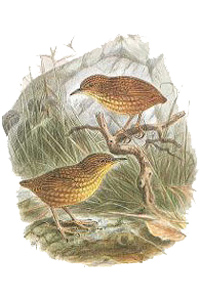
Stephens Island wren
Traversia lyalli
The Stephens Island wren, which was at one time on the mainland, was together with two of its previously extinct relatives, the only known flightless songbird in the world. The wren functioned ecologically as an avian mouse.
Stephens Island covers an area of 2.6 sq.km (1 sq.mile), and is the most distant island off the northern tip of the South Island adjoining the Marlborough Sounds. |
|
| |
The fate of Traversia lyalli is a classic but pathetic tale of New Zealand natural history.
In 1894, at a meeting of the Ornithologists' Club in London, a well-known collector the Hon W Rothschild, announced his possession of ten specimens of a rare bird which he had obtained from Henry Travers in Wellington, who got them from the Stephens Island lighthouse keeper.
The remarkable find had actually been accomplished by the very active lighthouse keeper's cat.
One specimen was also given to the New Zealand ornithological authority Sir Walter Buller, and a debate over who first named the bird occurred in Buller's favor.
The cat meanwhile, continued its duties, but it is not known how many specimens it eventually collected (or ate). Buller explained another five specimens, so Travers handled at least 16 wrens. It never occurred to anyone that it would be prudent to find out how many wrens were on the island.
Specimen collecting in 1894 is a stark contrast with conservation of today, that has brought back the Chatham Island black robin and the kakapo from the absolute brink of extinction.
The only consolation of the astute hunting of the cat is that it must have been well fed by the lighthouse keeper, to collect birds intact for the world to see the only flightless, and smallest songbird. |
|
| |
|
This was the only time in history that the news of a bird discovery was simultaneously reported to the world with its extinction. Needless to say, there is little known about the habits of Xenicus lyalli. It was only seen live on two occasions when it was disturbed from holes in rocks. It was thought to have been semi nocturnal and ran very fast like a mouse.
New Zealand wrens have rounded, wings and a very short tail. Males are smaller than females. Traversia lyalli had a mottled dark olive appearance on its upper surface with brown margins to the feathers. Its wings at the flexure were olive-green yellow, and its quills and tail were olive-green brown. The abdomen and sides of its body was olive-green, while its throat, foreneck and breast were olive-green yellow with dark margins to the feathers. The Stephens Island wren was very small with a 14 mm long bill, 46-49 mm wings, and a 17 mm long tail.
|
| |
North Island bush wren
Xenicus longipes stokesi
South Island bush wren
Xenicus longipes longipes
Both subspecies of the New Zealand bush wren Xenicus longipes were the fourth New Zealand wren extinction.
The last recorded sighting of the North Island subspecies Xenicus longipes stokesi was in the Te Urewera Range in 1955.
The South Island subspecies Xenicus longipes longipes was last sighted in Nelson Lakes National Park in 1968 and Kaimohu Island off Stewart Island in 1972. |
|

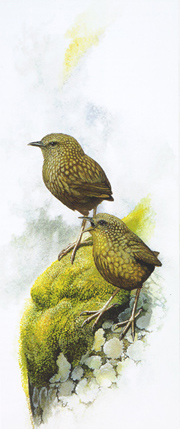
Stewart Island bush wren
(Stead's bush wren)
Xenicus longipes variabilis
At the turn of the 20th century, it was effectively extinct on Stewart Island, and limited to Big South Cape Island, Pukeweka Island, and Solomon Island which are near Stewart Island.
In 1964, ship rats got ashore on Big South Cape Island from a boat, and quickly spread to Pukeweka and Solomon Islands. This resulted in New Zealand's worst ecological disaster in modern times, causing the extinction of the Stewart Island snipe, the greater short-tailed bat, and Stead's bush wren. |
|
|
|
| |
2007 IUCN Red List of Threatened Species
Stephens Island wren
Traversia lyalli
Extinct
Bush wren
Xenicus longipes
Extinct
Rifleman
Acanthisitta chloris
Least concern
South Island wren (Rock wren)
Xenicus gilviventris
Vulnerable
2008 New Zealand Threat Classification System
Stephens Island wren
Traversia lyalli
Extinct
North Island bush wren
Xenicus longipes stokesi
Extinct
South Island bush wren
Xenicus longipes longipes
Extinct
Stewart Island bush wren
(Stead's bush wren)
Xenicus longipes variabilis
Extinct
North Island rifleman
Acanthisitta chloris granti
[D.1] At risk-declining
South Island rifleman
Acanthisitta chloris chloris
[D.1] At risk-declining
Rock wren
Xenicus gilviventris
[B.3] Nationally vulnerable
|
South Island wren
(Rock wren)
Xenicus gilviventris
The South Island wren Xenicus gilviventris, formerly known as the rock wren, is a member of the Acanthisittidae family of the Passeriformes order of birds. Unlike the other New Zealand wrens, the South Island wren is not truly a bush bird. It inhabits alpine and sub-alpine habitats throughout the western half of the South Island from the Nelson Lakes, through Westland to Fiordland.
Its distribution was formerly described as common. However, it is now fragmented, and recent sightings indicate that about 20 percent of known localities have had no sightings in the past 20 years [P. Gaze per R. Hitchmough in litt. 2005]. The total population is estimated to be less than 10,000 birds, and the range continues to decline. A 40 percent decline over a 20-year period occurred in the Murchison mountains (Willians 2007).
It prefers rock falls and crevices, and feeds on insects and spiders above and below ground. Rock wren survive in the harsh alpine environment below ground level when there is snow cover.
|
Rifleman (Titipounamu)
Acanthisitta chloris
The rifleman is New Zealand's smallest living endemic bird, with the male smaller than
the female. It is the only species of wren that has remained widely distributed throughout the
South Island, south of Te Aroha on the lower two-thirds of the North Island and on Great
Barrier Island and Little Barrier Island in the Hauraki Gulf. It has also been
successfully translocated to the restored Tiritiri Matangi Island.
The rifleman is not flightless, but it is a poor flier, and stays within a limited
territory. In searching for its food of foliage and insects in bark crevices |
|