| |
2011 IUCN Red List of Threatened
Species
Poor Knights weta
Deinacrida fallai
Vulnerable
Wetapunga (Little Barrier giant weta)
Deinacrida heteracantha
Vulnerable
Kaikoura weta
Deinacrida parva
Data deficient
Stephen's Island weta
Deinacrida rugosa
Vulnerable
Kauri snail
Paryphanta busbyi
Lower risk, near threatened
Gillies land snail
Paryphanta gilliesi
Data deficient
Hochstetter's land snail
Paryphanta hochstetteri
Data deficient
Woodformed land snail
Paryphanta lignaria
Data deficient
Ross' land snail
Paryphanta rossiana
Data deficient
Travers' land snail
Paryphanta traversi
Data deficient
Flax snail (Pupuharakeke)
Placostylus hongii
Vulnerable
Flax snail
Placostylus bolonsi
Vulnerable
Flax snail
Placostylus ambagiosus
Vulnerable
Giant land snail
Powelliphanta marchanti
Lower risk/near threatened |
|
|
| |
 |
| |
| |
|
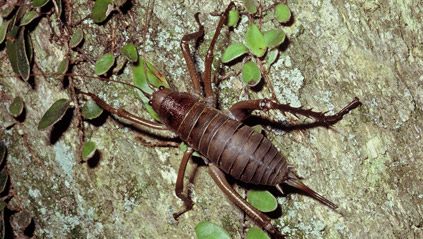
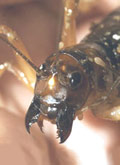
The weta is one of the world's most ancient species still living, with little change in 190 million years. New Zealand has the world's most diverse weta fauna of 70 endemic species. Seven Deinacrida species of rat-sized giant weta that have survived on offshore islands reach mammoth insect proportions - up to 150mm (6 inches) in length, taking the place of small rodents in the mammal-free ecology. A Little Barrier giant weta Deinacrida heteracantha has weighed 71g (2.5 oz) which is heavier than a thrush. It is the heaviest insect in the world.
 See more
 |
 |
| |
There are 21 Powelliphanta species and 51 subspecies that evolved during New Zealand's long isolation, and now occupy small isolated areas. They vary in size but some are gigantic, up to 90mm across. The largest is P. superba prouseorum in Kahurangi National Park. It is the size of a man's fist, and weighs 90g which is as much as a tui. Powelliphanta snails are living fossils, with an origin about 200 million years ago, and belong to the oldest family of carnivorous land snails on Earth.
See more
View larger image |
 |
| |
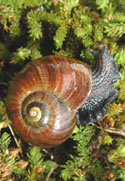
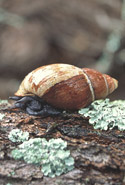
Kauri snail Paryphanta busbyi
Flax snail Placostylus hongii
Placostylus snails have coiled shells up to 115 mm (4.5 inches) in diameter. They belong to the oldest land snail family that originated 200 to 300 million years ago in the late Palaeozoic or early Mesozoic. Land snails were once wide-spread in the Northland region, but have suffered from habitat depletion and predation by introduced animals. The Kauri snail Paryphanta busbyi may live more than 20 years and is carnivorous, eating earthworms, insects, and insect lavae. They are also cannibals, eating other snails.
View full images |
 |
| |
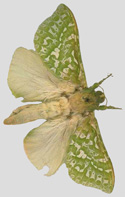
Puriri moth Aenetus virescens
The puriri moth is New Zealand's largest moth, with a wingspan of up to 150 mm. A. virescens is only found in the North Island, but has related species in Australia, New Caledonia and Papua New Guinea. The caterpillar starts life in a bracket fungus, and then bores a refuge tunnel in the trunk of its favorite puriri tree, or beech or putaputaweta. They feed on wound tissue around the entrance to the tunnel which is hidden by a silken tent, and grow to 70-80 mm during a 7-year life. Adult moths have no mouth and cannot feed, living only for a couple of days, just long enough to breed or be eaten by a morepork.
View larger images |
 |
| |
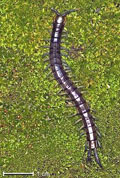
Giant centipede Cormocephalus rubriceps
A 25cm long giant centipede with armour plating and jointed legs has the appearance of an oversized caterpillar from Hell. Females carry their young to protect them. The giant centipede is a predacious carnivore of most earth fauna, capturing insects, spiders, snails, slugs and worms with claw-tipped pincers which inject a lethal poison. They are also known to kill small lizards. C. rubriceps can still be found in the North Island, however, the full-sized ones are only on rat-free offshore islands.
View larger image |
 |
| |
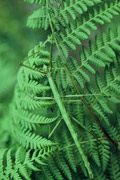
Stick insect Argosarchus,
Acanthoxyla and Clitarchus spp
There are about 20 species of stick insect in New Zealand. It is the country's largest insect. The green common stick insect Clitarchus hookeri (right) and other Acanthoxyla and Clitarchus species are 8 to 10cm long when mature. The largest is Argosarchus horridus which reaches 15cm in length. Many species are parthenogenic, meaning females are able to lay fertile eggs without mating with a male. Colour can vary from green to brown, even yellowish, amongst a species, possibly because of the particular habitat.
View larger image |
 |
| |
|
New Zealand has an unusual earthworm fauna, including famous giant species a metre long. The 173 species of native earthworms are another ancient remnant of Gondwana. The most spectacular, and New Zealand's largest worm is the North Auckland worm Spenceriella gigantia, which reaches 1.4 metres (55 inches) long and 11 mm (0.4 in) in width. The burrows are up to 20 mm in diameter, reaching a depth of 3.5 metres. The Maori worm can exceed 300 mm in length. S. gigantia luminesces so brightly at night that it is possible to read by the light from one worm.
See more |
|
| |
 |
| |
 |
|
|
| |
NEW ZEALAND ECOLOGY |
| |
|
|
GIGANTISM IN INSECTS |
| |
|
| |
New Zealand's invertebrate fauna has a diversity of large flightless ground-dwelling insects, with strong Gondwanan affinities. There are more than 1,000 snail species, many reaching an enormous size, capable of sucking up earthworms that are equally large by insect standards. Seventy endemic species of weta comprise another large insect group, in which 11 giant weta species are gigantic, with the largest being the world's heaviest insect. By comparison there are less than 12 ant species. Many New Zealand insects perform the ecological function of rodents in mammalian ecosystems. In New Zealand's contemporary disrupted ecosystems, introduced rats are predators of ecologically useful insects such as weta, and an assortment of other indigenous invertebrates, bats, and birds. |
|
| |
| |
|
| |
| |
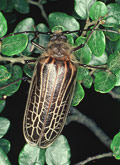
Huhu beetle Prionoplus reticularis
The huhu is a member of the Cerambycidae family of longhorn beetles, and is the largest New Zealand beetle, common throughout the country. It is 35 mm long with a pair of long, jointed antennae. Huhu are most active at night and can be heard flying into windows, attracted by the lights of the building. It is usually harmless but is capable of a powerful nip with its mandibles if mishandled. The grub stage is the well-known 70 mm long huhu grub which lives in timber. It was an edible delicacy of Maori who attest to its' buttery chicken taste.
View larger images |
 |
| |
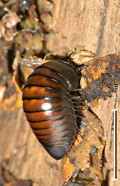
Giant pill millipede
Procyliosoma tuberculata
Myriapods also have monsters. A giant pill millipede can grow up to 5cm long and 2.5cm wide. They feed on decaying vegetation, and are widespread in the North Island and northern South Island. The giants only reach full size on offshore islands free of predators. The endemic pill millipede Procyliosoma striolatum (right) is smaller. New Zealand's five species of pill millipede belong to the order Sphaerotheriida, a group of 100 species with Gondwanan distribution in Australasia, South Africa and Madagascar.
View larger image |
 |
| |
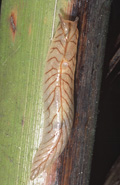
Leaf-veined slug
Athoracophorus bitentaculatus
New Zealand has thirty native slugs that are all endemic, many of which are not formerly described. Unlike the common European slug, they have two tentacles instead of four, and are more attractively colored. New Zealand slugs are unique in having a pinhole on their backs which, like a whale's blowhole, leads to a highly developed lung found in no other mollusc. The largest, the giant leaf-veined slug Amphiconophorus gigantea reaches 15cm long. Some species are widespread, but as with the related giant snails, many have been driven into relic forests and tussock grassland.
View 6 large slug images |
 |
| |
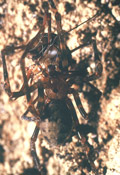
Nelson cave spider
Spelungula cavernicola
Spelungula cavernicola may be the missing link between primitive spiders from 350 million years ago and modern spiders. It is New Zealand's largest spider with a 3cm long body and a 13cm leg-span. Its size has scared the living daylights out of many a speleologist in the limestone caves of the Tasman Region where it is found. It is the only spider protected by the Wildlife Act 1953 and is listed as "Range restricted" in the 2005 New Zealand Threat Classification System.
View larger image |
 |
| |
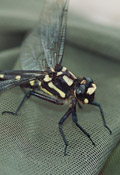
Bush giant dragonfly Uropetala carovei
The bush giant dragonfly is New Zealand's largest dragonfly, with a body length of 80-85 mm and a wingspan reaching 140 mm or more. It is found throughout both main islands, and is often seen and its loud clattering flight is heard when hovering around forest clearings during the summer. They are voracious predators that can consume 20 flies in an hour, and sometimes catch large cicadas. They are preyed upon by kingfishers, wasps and rats. The male has large, petal-shaped hind appendages.
View larger images |
 |
| |
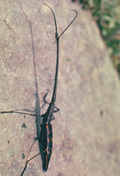
Giraffe weevil Lasiorhynchus barbicornis
The New Zealand giraffe weevil is the longest weevil in the world, with a length of 80 mm which is mainly taken up by the snout. In males, the antennae are near the tip of the snout, but in the smaller females, antennae are in the middle. L. barbicornis is found throughout New Zealand. Females chew holes in the wood of karaka, houhere, and pigeonwood trees to lay their eggs, and the hatched larvae tunnel further into the wood.
View larger images |
 |
| |
Photo credit
Top: Wetapunga (Giant weta), Dick Veitch, DoC.
Centre top: Giant weta, DoC.
Centre 2nd down: Giant land snail Powelliphanta 'Augustus', K.J. Walker, DoC.
Centre 3rd down: Flax snail Placostylus hongii, Terry C Green 1995, DoC.
Centre 5th down: Giant centipede Cormocephalus rubriceps, Alastair Robertson & Maria Minor, Copyright © Massey University.
Centre 6th down: Common stick insect Clitarchus hookeri, Rod Morris 1980, DoC.
Right top: Huhu beetle Prionoplus reticularis, Rod Morris 1985, DoC.
Right 2nd down: Giant pill millipede Procyliosoma striolatum, Alastair Robertson & Maria Minor, Copyright © Massey University Guide to New Zealand Soil Invertebrates.
Right 3rd down: Leaf-veined slug Athoracophorus bitentaculatus, Paul Schilov 2000, DoC.
Right 4th down: Nelson cave spider Spelungula cavernicola, Ian Millar, DoC.
Right 5th down: Bush giant dragonfly Uropetala carovei, Eric Edwards 2003, DoC.
Right 6th down: Giraffe weevil Lasiorhynchus barbicornis, 1977 DoC.
DoC images Crown Copyright © Department of Conservation. |
 |
|
| |
|