|
|
NEW ZEALAND ECOLOGY |
| |
|
|
MAMMALS |
| |
| |
The short-tailed bat Mystacina tuberculata, also known as the New Zealand lesser short-tailed bat, is the only remaining species of the Mystacinidae family, in the Chiroptera order.
It was abundant in the former near continuous tract of old growth forest of the central North Island, and other locations throughout New Zealand, but is now reduced to a population of 50,000 scattered in 13 principal known locations.
The Central, or Volcanic Plateau short-tailed bat subspecies Mystacina tuberculata rhyacobia is the most predominant, with a population of 40,000 bats. They are at seven North Island locations at Rangataua, Pureora, Kaimanawa, Whirinaki and Urewera, and Waitaanga, and Waitotara in the Taranaki region.
The Central subspecies is further divided into the Eastern central short-tailed bat M. tuberculata rhyacobia (eastern), and North-western central short-tailed bat M. tuberculata rhyacobia (north-western), which are both listed as 'range restricted' on the 2005 New Zealand Threat Classification System.
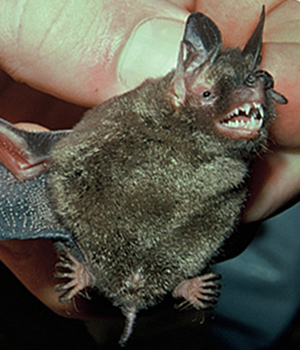
The Northern, or kauri forest short-tailed bat Mystacina tuberculata aupourica, is only at two Northland sites and on Little Barrier Island in the Hauraki Gulf. It is listed as 'nationally endangered'. |
| |
 |
| |
Northern short-tailed bat Mystacina tuberculata aupourica, Omahuta State Forest, Northland. Photo: Dick Veitch, Crown Copyright © 1975 Department of Conservation.
 View larger image View larger image |
| |
 |
| |
The Southern short-tailed bat Mystacina tuberculata tuberculata is limited to Codfish/Whenua Hou Island offshore from Stewart Island, Eglinton in the Fiordland area, and northwest Nelson, and is listed as 'nationally endangered'.
An isolated colony of 300 short-tailed bats was discovered in the late 1990s in the Waiohine Valley of Tararua Forest Park. Waiohine bats are genetically distinct, thought to be related to the Central and South Island subspecies.
They once populated beech forests when the North and South Islands were connected, and became isolated during a period of glaciation and volcanic activity 90,000 years ago. This endangered subspecies described as Southern North Island southern short-tailed bat M. tuberculata tuberculata (southern North Island) is listed as 'nationally critical' in the Threat Classification System.
Twenty Waiohine pups born from captured pregnant mothers have been released on Kapiti Island in an attempt to overcome the homing instinct in bats, to establish a second safe population in a predator-free habitat. |
| |
|
| |
"Short-tailed bats are the world's most terrestrial bats and represent the bat family's attempt to produce a mouse" [Diamond, 1990] |
| |
|
| |
|
The Mystacina tuberculata species is listed as 'vulnerable' on the 2004 IUCN Red List of Threatened Species.
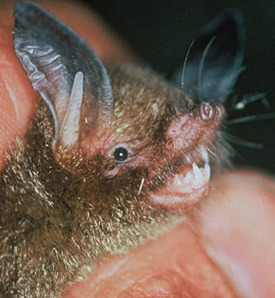
The short-tailed bat is robust and stocky, but weighs only 11 to 15 grams. Its appearance is quite unusual with its unproportionally large ears, from which a narrow and pointed tragus protrudes.
The scientific name "tuberculata" is derived from the short-tailed bat's strange primitive looking, double tubular nose that extends over its' lips.
Mystacina bats were preyed upon by the extinct laughing owl Sceloglaux albifacies. Today they are the prey of morepork Ninox novaeseelandiae and to a lesser extent the New Zealand falcon Falco novaeseelandiae.
Rats, stoats and ferile cats have been a major cause of native bat decline, and continue to be a problem in the large remaining native forest bat habitats.
Short-tailed bat populations are very susceptable to predation because only one pup is born in a season. Pups fly after 4-6 weeks, and grow to adult size within 8-12 weeks. |
| |
 |
| |
References
Diamond JM, New Zealand as an archipelago: An international perspective, Ecological restoration of New Zealand Islands, Conservation Sciences Publication No.2, Department of Conservation, 1990.
Hitchmough R, Bull L, Comarty P, New Zealand Threat Classification System lists 2005, Science & Technical Publishing, Department of Conservation, Wellington.
Kirsch J A, Hutcheon J M, Byrnes D G, & Lloyd B D. 1998. Affinites and historical zoogeography of the New Zealand Short-tailed bat, Mystacina tuberculata, Gray 1843, inferred from DNA-hybridization comparisons. Journal of Mammalian Evolution 5(1): 33-64.
Lloyd BD, Advances in New Zealand mammalogy 1990-2000: Short tailed bats. Journal of The Royal Society of New Zealand. Volume 31. No. I, March 2001, pp 59-81. |
| |
|
|
 |
| |
| |
|
| |
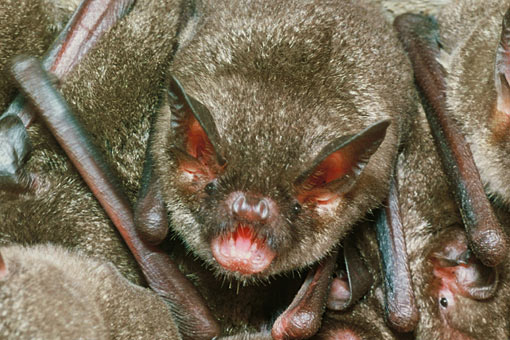
Above: A Central North Island short-tailed bat Mystacina tuberculata rhyacobia cluster, Ohakune, North Island, 1977. Photo B.D. Lloyd, Crown Copyright © Department of Conservation
View slideshow of five larger images
See greater short-tailed bat
See long-tailed bat |
| |
|
| |
Just as fast on the forest floor as in the air .....
Short-tailed bats are indeed very unusual, unique creatures. Many may regard them as wierd. They are undoubtedly a rare oddity, with remarkable bodily features and habits different from other bats.
In the prehuman New Zealand ecology, they did the job of mice in a normal mammalian ecology, and developed habits typical of so many of New Zealand's flightless and poor flying birds.
Most bats catch their food while in flight, but the short-tailed bat does things differently, spending a lot of time searching and eating off the forest floor.
It is the only bat that scrambles over the ground as well as it flies, however, it is a relatively slow flier, and seldom gets higher than three metres off the ground.
Mystacina are unique in their ability to fold their wings under a leathery membrane when grounded. This enables the use of their fore arms as front legs as they run through burrows and the forest floor as eagerly as a mouse. The short tail is free of the wing membrane.
The ability to tuck wings out of harms way also allows Mystacina to burrow into litter and humus on the forest floor for food, and into rotten logs and trees to carve out roosts and tunnels.
The short-tailed bat's thumb has a large, unusually well developed claw with a small talon. This is unique amongst the smaller bats.
Claws of the feet have talons as well, which helps agility on the ground, but also allows it to climb tree trunks and walk on branches in search of food, such as around epiphytes on kauri trees.
As found from bats in captivity, it will eat practically anything. A normal diet includes fruit, nectar, pollen and insects. It is one of the few bat species that eat plant matter. |
| |
 |
| |
Southern short-tailed bat, with its unproportionally large ears and protruding narrow, pointed tragus, Codfish Island. Photo B.D. Lloyd, Crown Copyright © Dept of Conservation
View slideshow of 5 larger images |
| |
|
| |
Short-tailed bats pollinate the flowers of woodrose Dactylanthus taylori, a rare parasitic plant that grows on tree roots. This saprophytic angiosperm is without photosynthetic tissues, and is only noticeable above the litter of the forest floor by the flower. Woodrose is a high pollen producer, and the only known flower that is pollinated by bats on the ground.
Mystacinids roost on there own or communally in hollow trees and tunnels they excavate in rotten wood. At Rangataua Forest on the lower slopes of Mt Ruapehu, where there are 7,000 bats, 5,500 may roost in a single tree.
Their body temperature cools when they are roosting. In cold and inclement weather they stay indoors, going into a 'torpor', and waking when the weather gets warmer. They do not hibernate, and have been known to forage on cold winter nights.
Short-tailed bats breed once a year from February to April, when the females form a nursery roost, and the males roost separately.
They are the only lek breeding micro-chiropteran. Males sing throughout the night from strategic trees to attract females, with sounds that can be partly heard by humans. Females travel as far as 10km to visit lekking males. |
| |
|
| |
|
| |
The world's sole survivor of an ancient bat lineage .....
The short-tailed bat Mystacina tuberculata, known also as the New Zealand lesser short-tailed bat, is the sole survivor of an ancient lineage.
It is the only remaining species in the family Mystacinidae which is presently endemic to New Zealand.
The short-tailed bat diverged from other species early in the evolution of bats, between 50 and 60 million years ago.
The Mystacinidae is one of 4 families in the super family Noctilionoidea. The super family also includes the Noctilionoidae, Mormoopidae and Phyllostomidae families which have been recognized for a long time as having a close relationship.
With the exception of Mystacina in New Zealand, the Noctilionoidea super family is restricted to central and south America. |
| |
 |
|
| |
| |
DNA-DNA hybridisation indicates Mystacina is the most basal group in the Noctilionoidea super family of bats. |
|
| |
| |
|
|
| |
The unique physical features of Mystacina have puzzled systemic biologists for the last century.
DNA- DNA hybridisation indicates Mystacina is the most basal group in the Noctilionoidea (Kirsch et al. 1998; Kirsch & Lloyd 1998).
Mystacinidae has only recently been associated with Noctilionidae, Mormoopidae and Phyllostomidae, after historically being placed with Verspertilionidae and Molossidae.
Morphological data has been inconclusive, but immunological data (Pierson 1986), and DNA data (Kirsch et al, Kennedy 1999) provide strong support for the current placement, going as far as suggesting that Mystacina is the sister group of all noctilionoids (Kirsch et al).
The previous conclusion of an origin of Mystacina in South America is overturned by its definition as a sister taxa of the genus Icarops (Hand et al 1998), which includes three species from fossils of the early Miocene in Northern Australia.
It is probable that Mystacina dispersed to New Zealand from Australia in the late Oligocene or early Miocene about 30 million years ago.
New Zealand was closer to Australia in the late Oligocene, and was emerging from a long period as a submerged, drowned continent. Historically most dispersals to New Zealand have been from Australia, at times assisted by island hopping, and by prevailing winds.
The genetic link of Mystacina to Icarops and the probability of dispersal across the Tasman Sea does not preclude a relationship to Noctilionoidea, however, it must be presumed that members of this group became extinct in Australia, but continued in South America.
|
| |
 |
| |
|
|
|