|
|
| |
 |
| |
Home > New Zealand ecology > Native ducks > Grey duck |
| |
| |

| |
The critically threatened grey duck Anas superciliosa superciliosa, also known as parera, is an endemic dabbling duck, the New Zealand subspecies of Pacific black duck. It belongs to the Anatidae family of swans, geese and ducks, which is part of the Anseriformes order.
Grey duck were commonly found in shallow wetlands and fresh water streams, and occasionally in estuaries throughout New Zealand until the 1950s. They have suffered severely from loss of habitat, and competition with the introduced mallard duck Anas platyrhynchos.
The subspecies A. superciliosa rogersi breeds in Australia, Indonesia and southern New Guinea; and A. superciliosa pelewensis breeds in northern New Guinea, and on southwest Pacific islands as far north as the Caroline Islands and Tahiti to the east. |
| |
|
 |
| |
| |
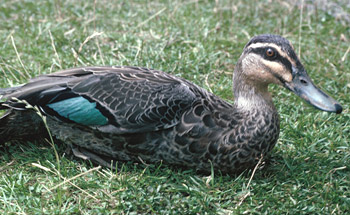
Above: Grey duck Anas superciliosa superciliosa
Photo C.D. Roderick, Crown Copyright © Department of Conservation.
 View slideshow of larger images View slideshow of larger images |
| |
 |
| |
The Chatham Islands are a stronghold for the New Zealand subspecies, as there appears to be a lower level of hybridisation with mallard ducks. Although now thinly scattered throughout the mainland, more prominent populations are found in the Northland, Waikato, Gisborne and Westland regions.
A distinguishing feature is a pattern of stripes extending from the bill back onto the head, with a thick dark patch over the top of the head, a thinner brown stripe through the eye, and another fainter line below from the beak opening. The three dark stripes alternate with cream coloured stripes either side of the dark eye stripe.
Males and females are alike in appearance, and similar to plumage of the female mallard. The grey duck's colouring is darker overall, and the head stripes more pronounced than the female mallard. |
| |
|
| |
Introduced mallards have taken over from grey duck, comprising 80 percent of New Zealand's dabbling duck population. |
| |
|
| |
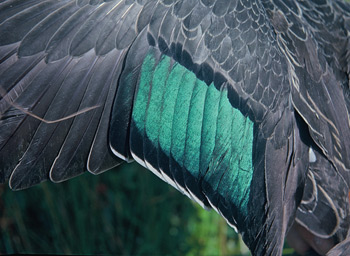
Grey duck have a white underwing and an iridescent turquoise green speculum on their wing (lower right), whereas the mallard speculum is blue or purple. The blue speculum tends to predominate on hybrids.
The grey duck's legs and feet are greenish brown, but the legs of hybrids tend to be orange-brown, taking on the color of the mallard's legs.
A grey duck's diet is typical of a dabbling duck - mostly aquatic snails and invertebrate insects, leaves and seeds of aquatic plants, and caterpillars and worms on pasture.
During the period from September to December they nest on the ground in dense grass cover or in a tree hollow, sometimes as far as 2 km from the feeding territory.
Four to nine eggs are laid, one each day, and packed in down while the female returns to the feeding area once or twice a day during the 26-28 day incubation period. The male takes off after 5 days to mate again. |
| |
|
| |
 |
|
|
| |
|
| |
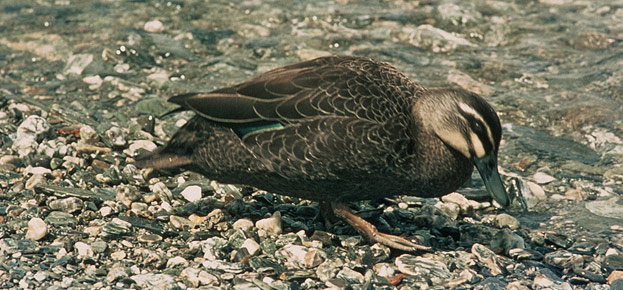
Above: Grey duck Anas superciliosa superciliosa
Photo: R. Sutton, Crown Copyright © Department of Conservation.
View slideshow of larger duck images |
| |
|
| |
Loss of pure-bred grey duck from interbreeding .....
While the rapid decline of grey duck has been caused by the loss of wetlands, and hunting, another principle cause is interbreeding with the very large population of introduced mallard Anas platyrhynchos. Very few pure-bred grey duck remain.
Mallard plumage is predominant in most mallard/grey duck hybrids, suggesting that male mallards mate with grey duck females, as opposed to the other way around, however, the level of contribution to the hybrid's ancestry cannot be ascertained from plumage.
The main reasons for displacement of the parera seem to be physical dominance of the larger mallards, combined with a marked population decline of the parera due to overhunting in the mid-20th century (Williams & Basse 2006). |
| |
 |
| |
Below: The green wing speculum of grey duck. Photo Crown Copyright © Department of Conservation. |
| |
 |
| |
Possible management actions include predator control, reduction of the mallard population, and protection of wetland habitats. Reduction of the male mallard population would directly reduce cross-breeding, and is the surest way of reducing mallards.
The similar appearance of female mallard with both sexes of grey duck makes identification difficult in reducing the mallard population, and interbreeding. The female mallard in flight may actually be a grey duck. |
| |
Genetic pollution from mallard ducks
The mallard was first introduced into New Zealand from Europe in the 1860s but failed to acclimatise. After eggs were imported in 1930 from California, the population multiplied so quickly that mallards are now regarded as an invasive species.
Mallards breed throughout Europe, Asia, North America, New Zealand and Australia. It is the ancestor of all domestic ducks belonging to the subfamily Anatinae, with the exception of a few species derived from the Muscovy duck Cairinia moschata.
Mallards can cross-breed with 63 duck species, causing a serious worldwide threat to the genetic integrity of native waterfowl. Eventually, hybrids ranging between species will reverse the speciation that has previously occurred over a very long period.
In addition to hybridisation with New Zealand grey duck, mallard interbreeding is polluting the genes of its descendent relatives, the American black duck, Hawaiian duck, Meller's duck, Florida duck, Mexican duck and yellow-billed duck which are endemic to their local regions.
The now extinct Mariana mallard Anas oustaleti was endemic to the Mariana Islands (which include Guam) in the Northwest Pacific Ocean. This species was possibly the result of hybridisation speciation between Anas superciliosa and mallard Anas platyrhynchos which migrated to the Marianas. A. oustaleti is not recognised as a species by IUCN and is sometimes regarded as a subspecies of mallard, or Pacific black duck A. superciliosa. |
| |
|
| |
|
|
One of New Zealand's three critically endangered ducks that is still hunted .....
As a result of rapid decline, the grey duck Anas superciliosa superciliosa was elevated to 'nationally critical' from 'nationally endangered' on the 2008 New Zealand Threat Classification System.
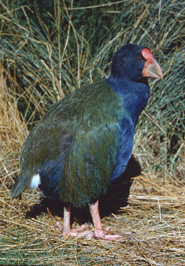
It joins South Island brown teal and Campbell Island teal as the three most critically endangered New Zealand ducks, and is now in the category of such iconic brink of extinction birds as black robin, kakapo and takahe.
The species Anas superciliosa, also known as Pacific black duck, is listed as 'least concern' on the 2009 IUCN Red List of Threatened Species.
| |
 |
| |
Despite its' rapid decline and 'nationally critical' status, the grey duck is still a game bird. |
| |
|
| |
Grey duck were once the main quarry of hunters, comprising 95 percent of the country's dabbling duck population.
The population declined drastically due to overhunting in the mid-20th century (Williams & Basse 2006).
But today, despite continued decline, it remains unprotected. According to the Wildlife Act 1953, grey duck and any cross of the species are "wildlife declared to be game".
In the Hawkes Bay Game Region, Fish & Game New Zealand have a mallard/grey daily bag limit of 6, comprising no more than 2 hen mallards and 3 grey duck for the season 2 May to 14 June 2009.
The mallard/grey limit in Taranaki is 10, and in Southland it is 15 from 4 May to 26 July.
Other native waterfowl that are hunted include Paradise shelduck Tadorna variegata, New Zealand shoveler Anas rhynchotis variegata, and pukeko Porphyrio melanotus.
Protected native ducks include the other four Anas species which are all teal, New Zealand scaup, Aythya novaeseelandiae, and blue duck Hymenolaimus malachorhynchos.
|
|