References
Boon, W.M., Kearvell, J.C., Daugherty, C.H., Chambers, G.K., 2001: Molecular systemics and conservation of kakariki (Cyanorampus spp), Science for Conservation, 176. 46p.
Fleming, C.A., 1976: New Zealand as a minor source of terrestrial plants and animals in the Pacific. Tuatara 22: 30-37.
|
|
|
| |
 |
| |
Home > New Zealand ecology > Parrots and parakeets > New Zealand red-crowned parakeet |
| |
| |
 |
| |
| |
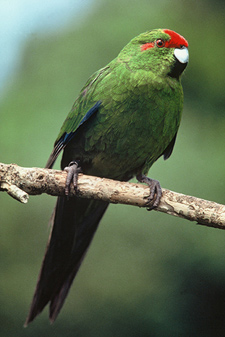
The New Zealand red-crowned parakeet Cyanoramphus novaezelandiae, also known as kakariki, is a member of the Psittacidae family of true parrots, of the Psittaciformes order of parrots. It is endemic to New Zealand.
Four subspecies are spread over a range extending from the tropics to the subantarctic. The New Zealand red-crowned parakeet Cyanoramphus novaezelandiae novaezelandiae was once abundant throughout New Zealand, but today it is rarely seen on the mainland North and South Islands.
C. novaezelandiae novaezelandiae is on Ewing Island in the subantarctic Auckland Islands 465 km south of the South Island, which is the world's most southern parrot location.
It is also the only parakeet on Stewart Island, and is holding its own quite well on some predator-free offshore islands, including Kapiti Island, and Hauraki Gulf islands such as Little Barrier Island, Cuvier Island, and Tiritiri Matangi Island where it was recently reintroduced. |
| |
 |
| |
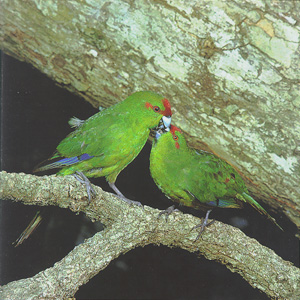
Above: A pair of New Zealand red-crowned parakeet Cyanoramphus novaezelandiae novaezelandiae
Photo Crown Copyright © Department of Conservation. |
| |
 |
| |
Two other subspecies, the Kermadec Island red-crowned parakeet C. n. cyanurus, and the Chatham Island red-crowned parakeet C. n. chathamensis are on the New Zealand subtropical Kermadec Island, and Chatham Island.
A fourth subspecies, the Lord Howe Island red-crowned parakeet C. n. subflavescens that was on Lord Howe Island in Australian territory is extinct.
The New Zealand red-crowned parakeet is endangered, listed as 'vulnerable' on the 2009 IUCN Red List of Threatened Species.
The New Zealand red-crowned parakeet, Chatham Island red-crowned parakeet, and Kermadec Island red-crowned parakeet all have threatened listings, respectively 'at risk-relict', 'at risk-naturally uncommon', and at 'risk-recovering' on the 2008 New Zealand Threat Classification System.
Eight red-crowned parakeets were once widely distributed throughout a region that represents the greater New Zealand continental landmass of 135 million years ago, that spread from New Caledonia to the subantarctic islands, and from the Lord Howe Rise to the Chatham Rise.
Genetic research [Boon, Kearvell, Daugherty and Chambers, 2001] reclassified the New Caledonian red-crowned parakeet Cyanoramphus saisetti, Norfolk Island red-crowned parakeet C. cooki, and Macquarie Island red-crowned parakeet C. erythrtis as separate species. They were previously subspecies of the New Zealand red-crowned parakeet.
The former red-crowned subspecies Reischek's parakeet, found only on the subantarctic Antipodes Island, is now C. hochstetteri.
Two parakeets on Australian oceanic islands, the Lord Howe Island red-crowned parakeet Cyanoramphus novaezelandiae subflavescens on subtropical Lord Howe Island, and the subantarctic Macquarie Island red-crowned parakeet are extinct.
The remaining Australian species, the Norfolk Island red-crowned parakeet C. cooki on tropical Norfolk Island is endangered with strong conservation action to save it.
The red-crowned parakeet diet includes beech, tussock and flax seeds, as well as fruits, flowers, leaves, shoots and invertebrates. It is quite adept at eating food held in its' claw.
Nests are in trunks or crevices and burrows, which increases vulnerability to predators such as stoats, cats and rats. About seven white eggs are laid. |
| |
|
|
| |
 |
| |
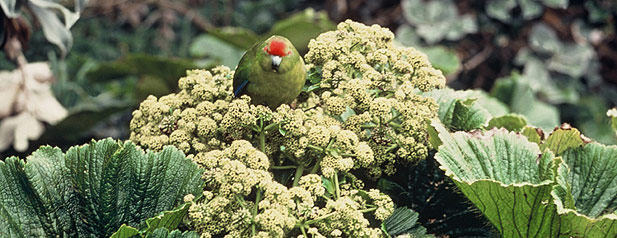
Above: A New Zealand red-crowned parakeet Cyanoramphus novaezelandiae novaezelandiae on the megaherb Stilbocarpa polaris on Ewing Island in the subantarctic Auckland Islands.
Photo Peter N. Johnson, Crown Copyright © Department of Conservation 1973. |
| |
|
| |
Parakeets from tropical paradise to the bleak but beautiful subantarctic islands ...
The geographical range of red-crowned parakeet is quite extraordinary. Parrots are normally associated with the warm tropics, so it is unexpected to find them on a cold, wet and wind-swept subantarctic island with very limited forest habitat, where the fauna is predominently ocean feeding seabirds such as albatross, and penguins and marine mammals.
The Cyanoramphus parakeets have adapted to a remarkably wide range of habitats from subantarctic tussock (C. unicolor, Antipodes Island) to tropical rainforests (C. saisetti, New Caledonia) [Boon et al. 2001].
Cyanoramphus is one of the many ancient links between the biota of New Zealand and New Caledonia [Boon et al. 2001]. |
| |
 |
| |
At latitude 50.5°South, the Auckland Islands are the most southern Cyanoramphus location and the world's second most southern location of living parakeets. |
| |
|
| |
With an apparent centre of origin in New Zealand, Cyanoramphus are believed to have dispersed across ocean barriers to many islands of the South Pacific [Fleming 1976].
The most ancient lineage of Cyanoramphus is the New Caledonian endemic C. salsetti, which is the likely source of radiation of species in new Zealand and its offshore islands.
This was probably the result of vicariant events due to the fluctuation in glacial ice followed by allopatric speciation in the last 450,0000-625,000 years [Boon et al. 2001].
In 1849, settlers came to Port Ross on the northeastern tip of Auckland Island. They very quickly became disillusioned with the consistent westerly gales and rain, a year-round winter climate, and impossible farming conditions, and abandoned the island after two years.
In the Auckland Islands the summer temperatures range from 5.5°C to 12°C, more than 1200 mm of rain falls on 320 days of the year, and the Furious Fifties westerly winds are interminable.
Domestic livestock struggled and humans could not live in the extreme subantarctic conditions, but parakeets and other terrestrial birds have survived for thousands of years.
A series of earth movements throughout the Triassic formed a land of continental proportions half the size of Australia. It extended north to New Caledonia, south of present New Zealand to the Campbell Plateau, west to the Lord Howe Rise, and east to the Chatham Rise.
Small islands remain today in these extremities of the former, now sunken Zealandia continent. These include New Zealand's subantarctic Campbell, Antipodes, and Auckland Islands; Australia's Lord Howe and Norfolk Islands in the west, and New Zealand's Chatham Islands in the east.
The distribution of parakeets that radiated from the New Zealand red-crowned parakeet Cyanoramphus novaezelandiae are presently, or have been present on all of these extremities of the Zealandia continent, which include New Caledonia, Lord Howe Island, Norfolk Island, the Chatham Islands, Antipodes Island, and the Auckland Islands, as well as the New Zealand mainland.
Flora and fauna that developed before and after Zealandia's separation from Gondwana 80 million years ago, became endemic to New Zealand.
Cyanoramphus dispersal during the last 500,000 years, throughout the Zealandia continental area, and beyond to Tahiti, does not establish a direct Gondwana connection, but it does show the success of
red-crowned parakeet radiation.
Unfortunately this changed with human settlement and the introduction of the deadly predators, stoats, cats and rats. Parakeets were abundant throughout the New Zealand mainland until 1840, when their downfall commenced with settlers killing them to make feather pillows.
Four Cyanoramphus extinctions have already occurred - the black-fronted parakeet C. zealandicus, and Society parakeet C. ulielamus in Tahiiti; and the Australian Macquarie Island and Lord Howe Island red-crowned parakeets.
Distribution of the other main species, yellow-crowned parakeet Cyanoramphus auriceps, tend to follow that of the New Zealand red-crowned parakeet. Yellow-crowned are also in the Auckland Islands.
Yellow-crowned populations have become scarce on the mainland islands, but it has faired a little better than red-crowned. On offshore islands the position is reversed with red-crowned being more dominant. |
| |
|
| |
|
|
| |
 |
A reflection of the lifestyle of New Zealand parakeets during the last ice-age .....
The rapid adaptive radiation of the Cyanoramphus genus was probably assisted by fluctuating glacial and interglacial intervals of 2 million to 10,000 years ago in the Pleistocene.
During the last glacial (before 14,000 years ago) and post glacial periods, predominant communities of grass and shrubs, with remnant patches of Nothofagus in the central North Island, provided a more limited habitat for Cyanoramphus parakeets on mainland New Zealand.
The mainland vegetation before the ice retreated resembled that of present Antipodes and Macquarie Islands. The present lifestyles of one of the more ancient Cyanoramphus lineages, C. unicolor, and Reischek's parakeet C. hochstetteri on Antipodes Island are a reflection of the New Zealand glacial conditions.
Campbell Island is another remote island in the subantarctic group that is nearly treeless. It is known from a bone specimen, to have been occupied by an unidentified parakeet that has long been extinct.
Reischek's parakeet appears to come from the mainland New Zealand stock of red-crowned parakeets, as the result of an independent colonisation event.
The extinct Macquarie Island red-crowned parakeet C. erythrotis also occupied habitat similar to that of Reischek's parakeet. This supports the hypothesis which suggests that Macquarie Island may have been colonised by Reischek's parakeet, from which the C. erythrotis species evolved.
| |
 |
| |
Livestock struggled, and humans could not live in the extreme subantarctic conditions, but parakeets have survived for thousands of years. |
| |
|
| |
The rapid transformation of the vegetation on the mainland between 10,000 and 9,000 years ago defines the end of the glacial period, and the beginning of the climate of today. Rimu quickly became the most predominant podocarp, and the start of a new forested habitat for mainland and offshore island parakeets. This was not so for the subantarctic island parakeets.
A principal parakeet habitat on Ewing Island now consists of native tree daisy Olearia lyalli that was probably introduced from the Snares Islands by sealers.
The Auckland Islands group has 200 native taxa, more than any of the other subantarctic islands. Its' forests are some of the most southern in the world. The montane dwarf forest is limited to 5 metre high Dracophylum and Coprosma species. Tussock grass and megaherb communities dominate the higher elevations.
Forest in coastal areas and sheltered gullies contain a small version of southern rata Metrosideros umbellata with an entangled profusion of twisted, knarled trunks, and a tight, flattened canopy resulting from the constant wind. The forest floor is mainly free of shrubs because of the acidic peat soils.
The Auckland Islands group has the most diverse avifauna of the five subantarctic islands. The most outstanding group are the 17 breeding species of albatross and petrel. There is a large population of one million sooty sheerwater.
There are four endemic land birds, the Auckland Island snipe Coenocorypha aucklandica aucklandica, Auckland Island rail Lewinia muelleri, and Auckland Island tomtit Petroica macrocephala marrineri. Tui, bellbird, pipit, New Zealand falcon, and banded dotterel Charadrius bicinctus exilis are also present.
The Auckland Islands have New Zealand's largest population of endemic, endangered yellow-eyed penguin Megadyptes antipodes.
|
| |
 |
| |
|