 |

|
Seabirds at risk from pirate fishing in Antarctic
"Pirate fishing companies have killed up to 700,000 seabirds snared by accident on their
fishing lines in Antarctic waters in the past six years ..."
10 March 2003
New Zealand Herald
Hopes rise for albatrosses
"The world's largest seabirds, the albatross family, should soon benefit from more
protection around the globe ..."
8 May 2003
BBC NEWS
Trip aims to save albatrosses
"A British sailor whose name is a byword for fortitude, John Ridgway, has picked a new challenge ..."
26 July 2003
BBC NEWS
UN alert on threat to birds
"New Zealand has earned special mention in a global environment report"
23 May 2002
New Zealand Herald
Albatrosses get prince's protection
"The Prince of Wales is supporting attempts to save endangered birds from death in the south Atlantic ..."
14 January 2002
BBC NEWS
Safe haven for albatrosses
"The world's biggest colony of black-browed albatrosses now faces a far more secure future. The colony is on one of two islands in the Falklands group ..."
6 March 2002
BBC NEWS
Anger as seabirds killed by longlines
"More than 300 protected seabirds, including albatross, have been killed by a commercial longline fishing boat off the New Zealand coast ..."
20 December 2001
New Zealand Herald
|
|
|
 |
Government plan to save endangered seabirds is not good enough
New Zealand Ministry of Fisheries Releases Draft National Plan of Action |
| |
|
On August 14th 2003, then fisheries Minister Pete Hodgson released a draft
plan aimed at reducing the number of seabirds killed through fishing. The draft plan will
apply to both commercial and non-commercial fisheries.
Albatross and petrels are particularly vulnerable to fishing as they dive for freshly
baited longline hooks. As many as 13 species of albatross and 16 species of petrel have
been recorded to have been caught in New Zealand fisheries during the past seven years.
Mr Hodgson claims in a statement that "within the fishing industry, many voluntary
steps have already been taken to reduce seabird mortality." |
 |
"The draft plan allows for the industry to advance these voluntary measures in the
first instance. However, if a voluntary approach fails, the plan allows the
Government to introduce mandatory measures."
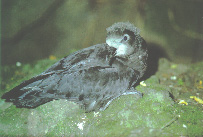
 Grey-faced petrel, Grey-faced petrel,
Geoff Moon
|
| |
|
 See the factsheet See the factsheet
or
full plan
of the"Draft National Plan of Action to Reduce the Incidental Catch
of Seabirds in New Zealand Fisheries" |
| |
Proposed government action, calling for voluntary measures by the fishing industry,
is severely inadequate
More than 10,000 albatrosses and petrels are killed each year in New Zealand
waters by trawling, longlines and set nets. The government's willingness to entrust the
fishing industry with voluntary action must be questioned, considering the industry's lack
of action and the kill rate of birds during the last 10 years.
The life of endangered seabirds is so critical, that the strongest possible mitigation
measures are necessary. Voluntary action will never achieve bycatch reduction
results as well as mandatory regulated and enforced requirements. A small number
of noncomplying boats can cause considerable damage. During six-weeks of fishing
for ling in the Chatham Rise at the end of 2001, 293 petrels and 11 albatross were
killed by longlines set by one Nelson-based fishing boat.
New Zealand is the world's largest seabird breeding region
More seabirds breed in New Zealand, in particular the subantarctic islands, than any
other place. The country is home to 54% of albatross, and half of the shearwaters,
petrels and prions of the world. The Royal albatross colony at Taiaroa Head on the
Otago Peninsula is the world's only mainland albatross breeding colony.
Sixteen species of albatross are identified as globally threatened in the 2000 IUCN Red
List, compared to only three in 1996. All of the 11 albatross species that breed in
New Zealand are listed(shown right). Eight of them only breed in New Zealand.
As a member of the United Nations International Plan of Action for Reducing the Incidental
Catch of Seabirds in Longline Fisheries (IPOA), New Zealand is committed to develop a
National Plan of Action (NPOA) to reduce the incidental catch of seabirds in New Zealand
fisheries. |
| |
 |
NEW ZEALAND SEABIRDS
2004 IUCN RED LIST
OF THREATENED SPECIES |
Albatross |
Critically endangered |
1 |
Endangered |
1 |
Vulnerable |
6 |
Lower risk-near threatened |
3 |
Petrel |
Critically endangered |
2 |
Endangered |
1 |
Vulnerable |
7 |
Lower risk-near threatened |
3 |
Shearwater |
Endangered |
1 |
Vulnerable |
1 |
Total |
26 |
|
|
| |
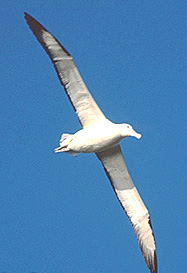
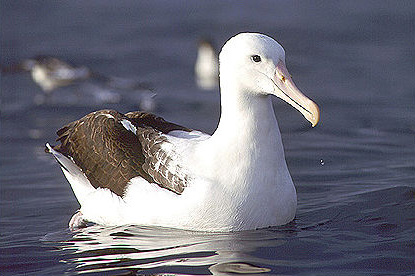
 Royal albatross Royal albatross
Only four other nations, Australia, France's Southern Territories, South Africa, and the
United Kingdom's Overseas Territories get the privilege of albatross breeding in the
southern oceans. New Zealand has a heavy burden, but also the responsibility to set
the highest standards of protection for seabirds both in New Zealand waters when they are
feeding, and when they are breeding on land.
BirdLife International reports that worldwide, more than 300,000 seabirds are killed
by longline fishing each year. A total of 26 species of seabirds, including 17
species of albatrosses, are in danger of extinction because of deaths caused by longlining.
Albatrosses and petrels habitually follow boats to scavenge discarded fish waste.
They are attracted to the bait on hooks of longlines as they enter the water, and are dragged
under to drown, or are seriously injured by the hook. |
|
Mitigation measures that prevent seabird drowning from longline fishing are currently
being effectively used in some areas. One effective method involves setting the line
through an enclosed tube attached to the boat and extending below the surface of the water,
which separates the bait from the birds.
|
|
|
|
 |
| |
|
Tori lines with streamers attached are used to distract the birds. Another common
sense measure is the dumping of fish waste when lines are not being set.
In regulating fishing in Antarctic waters, the Commission for the Conservation of Antarctic
Marine Living Resources (CCAMLR) requires closure of areas and seasons with respect to bird
activity (at times for 5 months in some areas), use of tori lines, night setting, weighted
hooks, 100 percent observer coverage, and restriction of offal dumping during the setting
of longlines.
New Zealand boats fishing in Antarctic waters are required to meet CCAMLR mandatory
requirements, but are not required to operate with the same preventative measures in
New Zealand waters. New Zealand is a member of CCAMLR and has supported strong
regulation in Antarctic waters, but is not prepared to impose the same requirements
in New Zealand waters.
Japanese tuna boats operating in New Zealand waters have lowered annual seabird by-catch
from 4,000 birds to less than 20 birds. A significant reason for this is the
continuous presence of observers on all boats and strict requirements. Yet a New
Zealand fishing boat caught 304 seabirds in one six-week voyage.
Currently the only measure in place to reduce seabird deaths is a requirement for
tuna boats to use tori or bird scaring lines. There are no requirements for other
longline vessels fishing for other species, or for trawlers or set netters.
|
|
|