|
NEW ZEALAND ECOLOGY |
| |
|
|
BIG CONIFER AND BROADLEAF TREES |
| |
| |
The massive kauri Agathis australis is part of the ancient Araucariaceae family, consisting of the genera Agathis and Araucaria, that is now represented by evergreen trees only in the Southern Hemisphere.
Araucarian conifers were at their peak during the Jurassic and Cretaceous with distribution throughout the northern and southern hemispheres.
Agathis australis is the only member of the Araucariaceae family now native and endemic to New Zealand, however, there is Araucaria macro fossil material from the Miocene. The ancestor of kauri would be recognised because it has scarcely changed since its Gondwana origin.
The kauri exceeds all other New Zealand trees in its antiquity. The genus Agathis evolved from the Araucariacean fossil Araucariacites australis. Fossil pollen of Araucariacites was present in Gondwana, in what became the New Zealand land area, 230 million years ago during the Triassic, and continued through Jurassic times until the Oligocene period.
The genus Agathis is first dated from fossils in the middle Cretaceous 100 million years ago. By the Oligocene 30 million years ago, it had replaced its Araucariacites australis ancestor. |
| |
 |
| |
The largest living kauri is Tane Mahuta standing for 2,100 years with its' straight column-like trunk of 13.7 metres in girth and 4.4 metres in diameter, clear of branches to a height of 18 metres. It is 52 metres high and contains 245 cubic metres of timber. |
| |
|
| |
Kauri Agathis australis is listed as 'lower risk - conservation dependent'' in the IUCN Red List of Threatened Species
There are 16 species of the genus Araucaria, which include the well known monkey puzzle tree, A. araucana, found only in Chile; the Norfolk Island pine, A. heterophylla; and the candelabra tree, A. angustifolia from Brazil.
Another 19 Agathis species are native to the Western Pacific countries of Australia, Indonesia, Malaysia, Philippines, Fiji, New Caledonia, and Celebes.
They are some of the largest and longest growing trees in the world, with massive straight trunks free of branches to a great height, and huge branches (as large as 2m in diameter in A. australis) in the crown. More timber can be cut from a single kauri than any tree of similar size, so it was a popular tree for the timber industry. |
| |
| |
| |
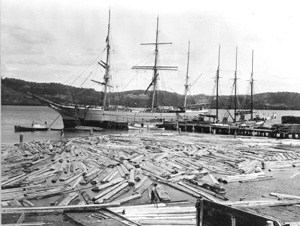
Below left: Kauri timber was the first New Zealand natural resource to be extracted by Europeans, and the first resource to be exported overseas. The barque Ashmore and scow Korora and a boom at Kokukohu, Hokianga. Photo Northwood Brothers, 1910.
 See Kauri logging and the export industry See Kauri logging and the export industry
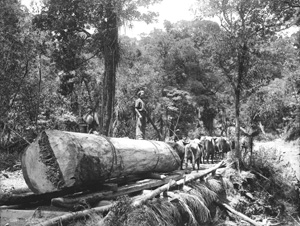
Below right: A team of bullocks hauling a kauri log in North Auckland. Photo Arthur James Northwood, 1918. Permission of the Alexander Turnbull Library, Wellington, New Zealand, must be obtained before any re-use of these images.
View larger image |
| |
|
|
 |
| |
| |
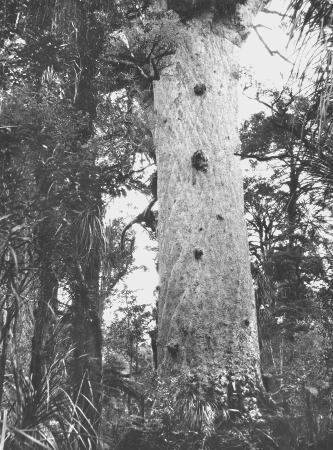
Above: The largest living kauri Tane Mahuta (date and photographer unknown). The mammoth size is shown by the man at the base.
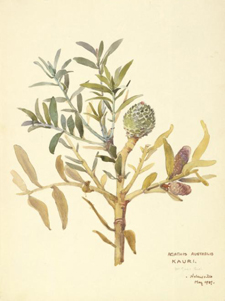
Right: Holdsworth, Alice Mabel, 1878-1963, Agathis australis Kauri. Mr Guy's bush Helensville, May 1937. Permission of the Alexander Turnbull Library, Wellington, New Zealand, must be obtained before any re-use of these images
Return to big conifer and broadleaf trees |
| |
|
| |
The New Zealand kauri is the largest Agathis species. Australia's South Queensland kauri, Agathis robusta is very similar to the New Zealand kauri, but does not grow as big. A large tropical species, A. alba is valued for its timber and gum in Indonesia and Malaysia.
New Zealand kauri Agathis australis is the oldest of the living species of this genus. Molecular sequence data [Stockler et al., 2002] shows it has been present in New Zealand since Gondwana times, and survived Oligocene drowning of Zealandia. It subsequently dispersed out of New Zealand to Australia, Fiji, Vanuatu, and Melanesia.
Kauri once covered 1.6 million hectares (4 million acres) in the northern half of the North Island, extending as far south as Kawhia on the west coast, and just past Tauranga on the east coast. There is no indication that they have ever grown naturally in other parts of the country.
After rampant destruction of kauri forests from logging, fire, and clearing for pastural grazing, the area has shrunk to a mere 7,000 hectares (18,000 acres).
The extent of kauri logging is shown by Kauri Timber Company operations from 1896 to 1903, when 267 million super feet of timber was milled. This was part of the greatest surge of production that severely depleted forests. After 1907 production was dramatically reduced.
Young kauri up to 80 years old have a vastly different bark than mature trees. The trunk of a mature kauri is kept free of epiphytes by continual shedding of thick flakes of bark, which accumulate to form a large mound that eventually decays into a rich humus penetrated by the roots.
Contrary to the clean trunk, the junction of the massive branches can house a mini-ecosystem of epiphytes, lianes, mosses, ferns and insects. |
|
|
|
|
|
Tree trunks as wide as a two lane road
The kauri is revered by the Maori people, who believe it possesses its own spirit. They have named individual large trees.
The largest living kauri is Tane Mahuta or "Lord of the Forest" (above left), still standing after 2,100 years in the Waipoua Forest in Northland.
Tane Mahuta's massive straight column-like trunk has a girth of 13.7 metres (45 feet) which is 4.4 metres (14 ft) in diameter, and is clear of branches up to a height of 18 metres (59 ft).
Tane Mahuta reaches 52 metres (169 ft) in height, and is estimated to contain 245 cubic metres (8,630 cub.ft) of timber.
Another big living tree, Te Matua Ngahere or "Father of the Forest", has a wider trunk with a 16.4 metre (54 ft) girth and 5.2 metre (17.1 ft) diameter, however, the clear trunk only goes up to 10 metres, and it is not as tall - just 30 metres (98 ft).
An extraordinary Northland kauri named Kairaru which was destroyed by fire in the 1880s near Kaihau, was estimated to have lived for 4,000 years.
Kairaru was three times larger than Tane Mahuta, estimated to have a volume of 450 cub.m (16,000 cub.ft) of commercial lumber. Kairaru would have contained more timber volume than today's largest giant redwoods of California.
The Coromandel Peninsula is another stronghold of kauri, where natural regeneration has been occurring for some time, and where a few large specimens have been spared from fire and milling.
The size of lost kauri giants can be seen above the Kauaeranga Valley east of Thames. A number of massive stumps, preserved by the durability of kauri, are 6 metres (20 ft) across.
The largest kauri was measured in 1850 at Mill Creek, Mercury Bay on the east coast of the Coromandel Peninsula. It had a girth of 23.4 metres (77 ft), which is a diameter of 7.45 metres (24.5 ft). The first branches were 22 metres above the ground.
|
|